From Diagnosis to Goodbye Facilitator Program
Become a Certified From Diagnosis to Goodbye Facilitator
Help people find their voice without becoming the loudest voice in the room.
From Diagnosis to Goodbye was created to help patients, families, caregivers, professionals, and communities hear the human voices that can become lost during serious illness, caregiving, end of life, and grief.
The Certified From Diagnosis to Goodbye Facilitator program prepares individuals to responsibly guide conversations, groups, workshops, and learning experiences using the principles and approved resources of From Diagnosis to Goodbye.
This is more than learning how to lead a discussion. It is learning how to create space for another person's experience without taking it over.
“The facilitator's voice should never become the loudest voice in the room.”
Voices in the Journey
Every serious-illness and grief journey contains voices that deserve to be heard.
The Patient's Voice
“This is happening to me.”
The person experiencing illness remains a person—not simply a diagnosis, condition, prognosis, or care plan.
The Family's Voice
“This is happening to someone I love.”
Families may carry fear, hope, uncertainty, exhaustion, grief, questions, and difficult decisions while trying to support someone they love.
The Caregiver's Voice
“I am trying to hold everything together.”
Behind the practical responsibilities of caregiving may be exhaustion, changing roles, anticipatory grief, uncertainty, and loss.
The Professional or Helper's Voice
“I am here to help.”
Healthcare professionals, chaplains, pastors, volunteers, facilitators, and other helpers bring valuable knowledge and support—but expertise should inform the room without owning the room.
The Voice of Grief
“Something is changing, and I am already losing something.”
Grief can begin long before a death. Illness may bring losses involving independence, identity, relationships, roles, plans, abilities, home, and the future someone expected to have.
A Different Way to Facilitate
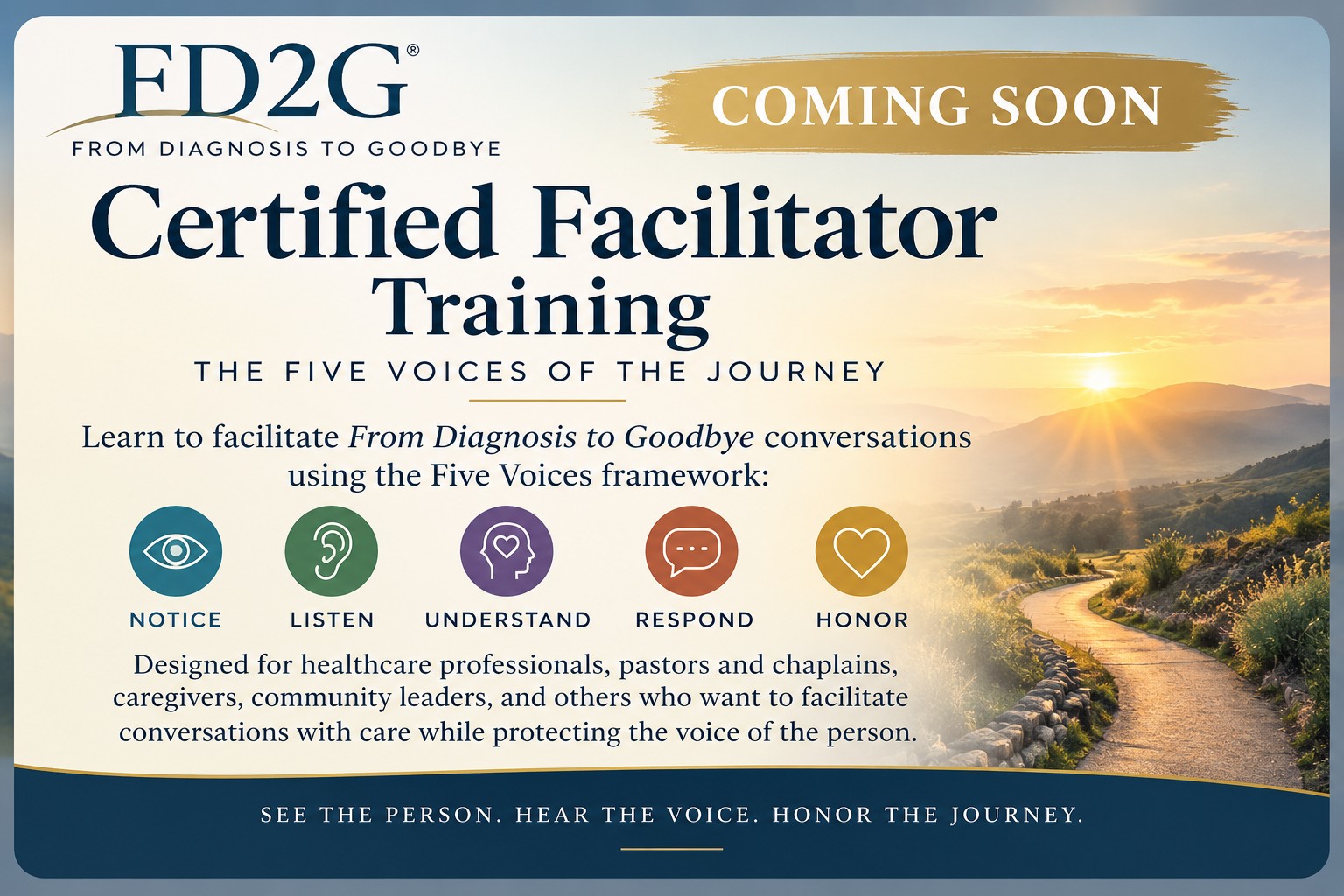
Certified facilitators learn a five-part framework:
NOTICE→LISTEN→UNDERSTAND→RESPOND→HONOR
NOTICE
Notice what is already happening—seeing the person and recognizing who or what may be overlooked.
LISTEN
Listen to hear the person's experience while creating invitation and space without forcing disclosure.
UNDERSTAND
Discover the story, perspective, relationships, fears, values, beliefs, and circumstances behind the voice—and help meaning emerge without defining it for someone else.
RESPOND
Determine what the conversation needs and respond without taking over, correcting, fixing, diagnosing, or exceeding the facilitator's role.
HONOR
Protect personhood, autonomy, dignity, voice, culture, spirituality, privacy, boundaries, and the person's journey.
The voices in the room tell facilitators who and what to hear.
The Five Voices Framework teaches them how to respond.
Who Can Become a Facilitator?
Facilitator training is designed for people who want to responsibly use the From Diagnosis to Goodbye approach in settings such as hospice, healthcare, caregiving, bereavement, ministry, senior living, community education, and support groups.
Potential facilitators may include
You do not have to become a chaplain to become a From Diagnosis to Goodbye facilitator.
Certification is specific to facilitating the From Diagnosis to Goodbye program and does not independently confer clinical, counseling, healthcare, ministry, or professional chaplaincy credentials.
The Facilitator Training
The Five Voices of the Journey
Certified Facilitator Training for From Diagnosis to Goodbye
The certification course consists of five learning sessions:
Session One — NOTICE
Seeing the Voices Already in the Room
Session Two — LISTEN
Creating Space Without Taking Over
Session Three — UNDERSTAND
Hearing What Is Said—and What May Be Beneath It
Session Four — RESPOND
Responding to What the Conversation Needs
Session Five — HONOR
Holding the Person, the Story, and the Boundaries
Each session combines teaching, realistic facilitation scenarios, reflection, and assessment.
Explore the TrainingBecoming Certified
Certification is earned through preparation and demonstrated understanding—not simply by purchasing a course.
To become a Certified From Diagnosis to Goodbye Facilitator, participants complete the five-session facilitator training, required session assessments, and the final Facilitator Certification Assessment.
Participants also affirm the Certified Facilitator Code of Ethics and accept the Authorized Facilitator Agreement.
Successful participants receive an individual certification number and a 12-month certification.
View Certification RequirementsCertification Means Authorization
The From Diagnosis to Goodbye program, methodology, curriculum, and authorized resources are protected intellectual property.
Becoming certified does not transfer ownership of the program.
It provides time-limited authorization to responsibly facilitate the approved program according to its standards.
“Certification is not ownership. Certification is authorization to responsibly carry the work.”
Certified facilitators maintain their authorization through annual renewal.
Learn About Annual RenewalFor Hospices, Healthcare Organizations, Churches & Community Organizations
Organizations that want to formally implement From Diagnosis to Goodbye may participate through organizational licensing.
A facilitator is certified.
An organization is licensed.
Organizational licensing can support implementation within hospices, hospitals and healthcare organizations, senior-living communities, churches and ministries, bereavement programs, caregiver programs, community organizations, and other approved settings.
Individuals delivering the protected program must maintain the facilitator credentials required by the program.
Explore Organizational LicensingCarry the Work Responsibly
From Diagnosis to Goodbye began with a simple conviction:
People facing serious illness, caregiving, dying, and grief deserve to remain more than the circumstances happening around them.
Their voices matter.
Their stories matter.
Their questions matter.
Their silence matters.
And those entrusted with accompanying them must learn when to speak—and when to make room.
Become a Certified From Diagnosis to Goodbye Facilitator
See the person. Hear the voice. Honor the journey.
Explore Facilitator Training